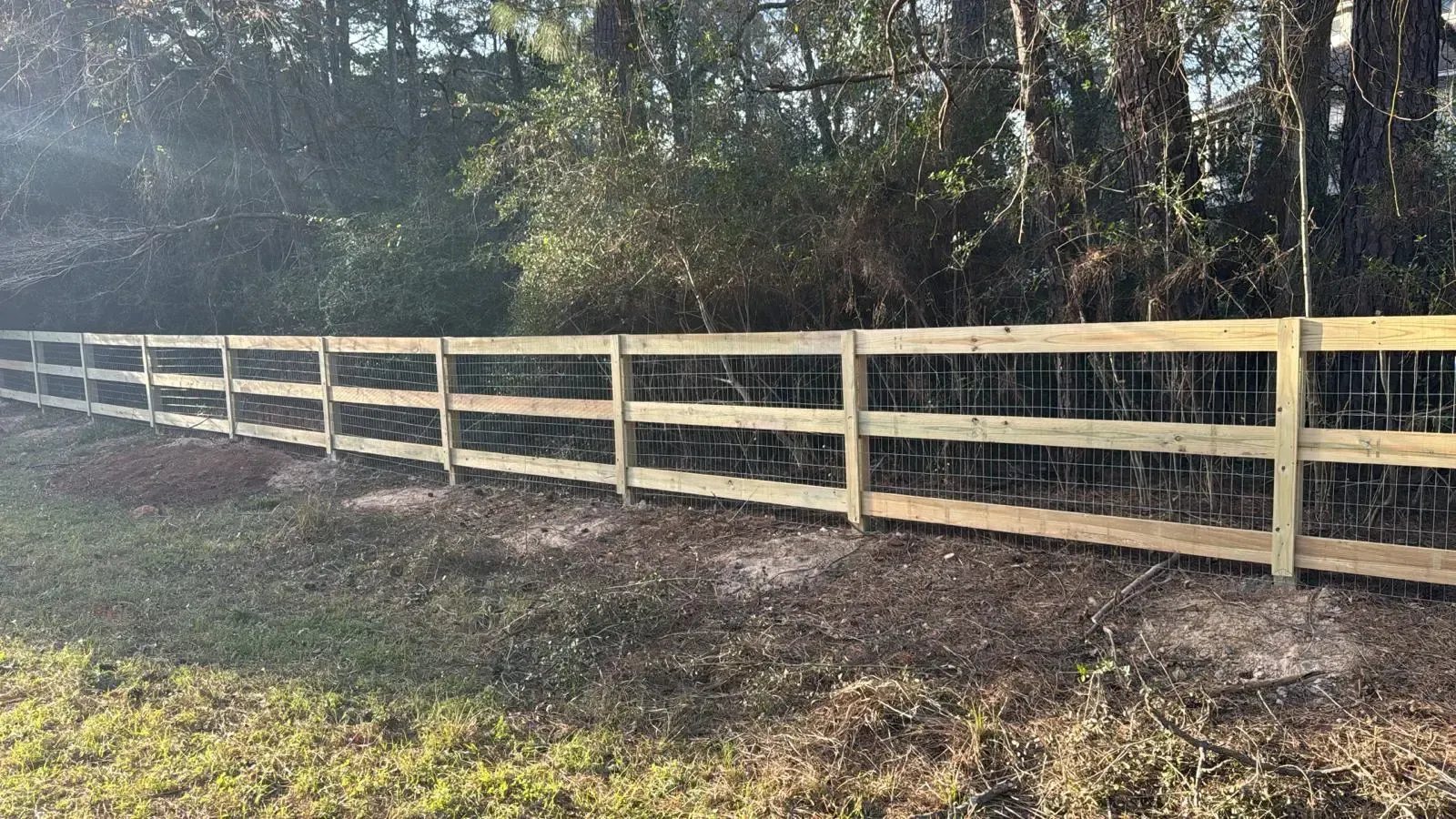
Wood-and-Wire Fencing for Horses, Cattle & Acreage in Montgomery County
Wood-and-wire fencing is one of the most practical fence options for many acreage properties in Montgomery County. It combines the traditional look of wood posts and rails with the added function of wire fencing. For horses, cattle, dogs, livestock areas, and long property boundaries, this combination can provide both appearance and performance.
Many rural and acreage properties need more than a decorative fence. They need a layout that can handle animals, long fence runs, uneven ground, wooded areas, gates, and day-to-day property use. That is where wood-and-wire fencing can be a strong option.
If you are planning Montgomery acreage fencing, wood-and-wire may be worth considering for both durability and function.
Key Takeaways
- Wood-and-wire fencing combines ranch-style appearance with stronger containment for acreage properties.
- This fence style can be useful for horses, cattle, dogs, pastures, and long property boundaries.
- No-climb wire can improve animal safety and reduce the risk of hooves or legs getting caught.
- Long perimeter fence runs should be planned around terrain, gates, maintenance access, and livestock movement.
- Wood-and-wire fencing can pair well with ranch entry gates and driveway gates for Montgomery County acreage properties.
What Is Wood-and-Wire Fencing?
Wood-and-wire fencing typically uses wood posts, rails, or framing combined with wire mesh or no-climb wire. The wood creates structure and a ranch-style appearance, while the wire helps close gaps and improve containment.
This makes it different from a simple 3-rail or 4-board fence. A board fence may look attractive, but animals may still pass through, push through, or interact with the openings. Adding wire improves function without losing the ranch appearance.
Wood-and-wire fencing can be used for:
- Horse areas
- Cattle areas
- Pastures
- Acreage boundaries
- Dog runs
- Long perimeter fencing
- Rural homes
- Ranch entrances
- Mixed-use properties
The specific design depends on the property and the animals involved.
Why It Works for Montgomery County Acreage
Montgomery County includes ranches, acreage homes, wooded lots, lake-area properties, and rural roads. Many properties have long fence lines and need a fence that balances cost, function, and appearance.
Wood-and-wire fencing works well because it can be adapted to different parts of the property. For example, a property may use a decorative board fence near the entrance and wood-and-wire fencing around pastures or side boundaries.
It is also useful where visibility matters. Unlike a full privacy fence, wood-and-wire fencing keeps the land more open visually while still creating a usable boundary.
For rural properties, it can help with:
- Long property lines
- Livestock containment
- Pasture separation
- Boundary definition
- Animal safety
- Visibility across the land
- Driveway and gate planning
Ark Fence Company’s ranch and farm fencing services include practical options for acreage, livestock, and property boundary needs.
Wood-and-Wire Fencing for Horses
Horse fencing should be visible, safe, and properly planned. Horses can be sensitive to fence design, and the wrong fence may increase the risk of injury.
Wood-and-wire fencing can work well for horse properties when the wire type and layout are chosen carefully. No-climb wire is often preferred because the smaller openings help reduce the chance of a hoof getting caught. Wood rails can also improve visibility, making the fence easier for horses to see.
Horse property fencing should consider:
- Fence height
- Wire opening size
- Post spacing
- Gate placement
- Pasture layout
- Sharp edges or exposed hardware
- Visibility
- Maintenance access
The goal is to create a fence that contains animals while reducing unnecessary risks.
Wood-and-Wire Fencing for Cattle
Cattle fencing needs to be strong, practical, and suited to the property layout. Cattle may push against fencing, especially near feeding areas, gates, or pressure points. For that reason, fence strength and post stability matter.
Wood-and-wire fencing can be useful for cattle areas because it combines sturdy wood framing with wire containment. Depending on the property, the fence may need stronger corners, bracing, and gates designed for equipment or livestock movement.
For cattle properties, fence planning should include:
- Pasture boundaries
- Gate widths
- Equipment access
- Water or feeding areas
- Fence tension
- Corner bracing
- Long-term maintenance
The best cattle fence layout depends on how the animals move across the land.
No-Climb Wire and Livestock Safety
No-climb wire is often used where animal safety is a priority. It has smaller openings than some other wire types, which can help prevent animals from stepping through or getting caught.
For horses, no-climb wire is commonly used because it provides better containment while reducing certain safety concerns. For smaller animals or mixed-use properties, wire selection can make a major difference.
No-climb wire can be paired with wood posts and rails to create a fence that looks like ranch fencing but performs more like a containment fence.
Long Perimeter Fence Runs
Many Montgomery County properties have long perimeter lines. For these projects, cost and maintenance become important. A full board fence across a large property may not always be practical. Wood-and-wire can sometimes offer a better balance.
Long fence runs should be planned carefully. Terrain, trees, drainage, access points, and property corners all affect installation. Gate locations should also be planned before the fence is built.
For long perimeter projects, property owners should think about:
- Total linear footage
- Property boundary accuracy
- Maintenance access
- Animal movement
- Fence visibility
- Gate placement
- Future expansion
- Storm exposure
The goal is to build a fence that works across the full property, not just near the entrance.
Pairing Wood-and-Wire Fencing with Driveway Gates
Many acreage properties also need gates. A wood-and-wire fence may connect to a ranch entry gate, driveway gate, pasture gate, or equipment gate.
Driveway gates can improve security and access control, especially on long rural driveways. They may include manual gates, ornamental gates, automatic openers, keypad entry, or solar opener options.
For properties that need both fencing and gate work, Ark Fence Company can help with driveway gates in Montgomery TX and access planning.
Repairing Older Wood-and-Wire Fences
Older wood-and-wire fences may need repair over time. Posts can lean, wire can loosen, rails can break, and gates can sag. Storms, moisture, livestock pressure, and age can all affect the fence.
If the damage is limited, repair may be enough. If the posts, wire, and gates are failing across multiple areas, replacement may be the better long-term choice.
For damaged acreage fencing, Ark Fence Company can help evaluate fence repair in Montgomery TX.
Request an Acreage Fence Estimate
Wood-and-wire fencing can be a smart choice for horses, cattle, livestock areas, and long acreage boundaries in Montgomery County. It offers a strong mix of ranch appearance, visibility, containment, and practical function.
Need wood-and-wire fencing for horses, cattle, or acreage? Call for Ranch Fencing.